

UV and DTF digital printers
UV printers for bottles, tumblers and objects, and DTF printers for textiles and UV DTF: personalisation without screens or clichés.
Technical guide
UV and DTF digital printing: what it is and which printer to choose
Digital printing deposits the ink drop by drop from an inkjet printhead, straight from the file, with no screen or cliché. That is why it pays off on short runs, part-by-part personalisation and full-colour designs, where preparing a screen printing screen or a pad printing cliché does not pay for itself. The IBPRINT catalogue brings together two families: UV printers, which print directly onto the object, and DTF printers, which print onto film for later transfer.
What is a UV printer?
It is an inkjet printer whose inks do not dry by evaporation: they cure instantly under a UV-LED lamp that travels with the printhead. Because the ink is fixed as soon as it touches the part, it can print directly onto non-porous materials such as glass, stainless steel, metal, acrylic, rigid plastics or ceramics, and also onto wood or leather. Layering white, colour and varnish gives opacity on dark or transparent backgrounds, spot gloss and tactile raised texture.
What is DTF and how does it work?
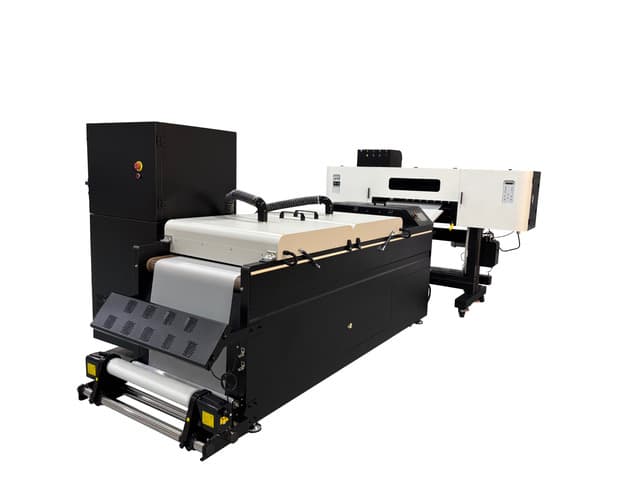
DTF (Direct to Film) is printing onto film for later transfer to fabric. The printer lays down the colour and a layer of white on PET film; a hot-melt powder adhesive is applied to the still-wet ink, melted with heat, and the transfer is pressed onto the garment with a heat press. It works on cotton, polyester, blends, denim, nylon or leather without pretreating the garment, and gives a flexible, wash-resistant print.
What is UV DTF?
UV DTF applies the DTF idea to rigid objects. It is printed with UV ink onto an adhesive film, laminated with a transfer film and the design is applied by pressure, cold and with no press, onto cups, flasks, boxes, containers or promotional items with shapes a flatbed cannot reach. It is not a textile technique: for garments, conventional DTF.
Flatbed or cylindrical UV printer?
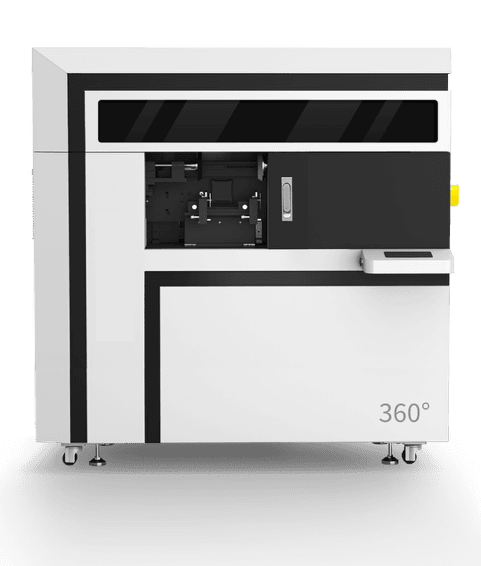
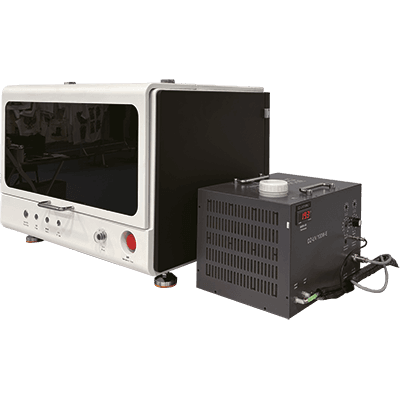
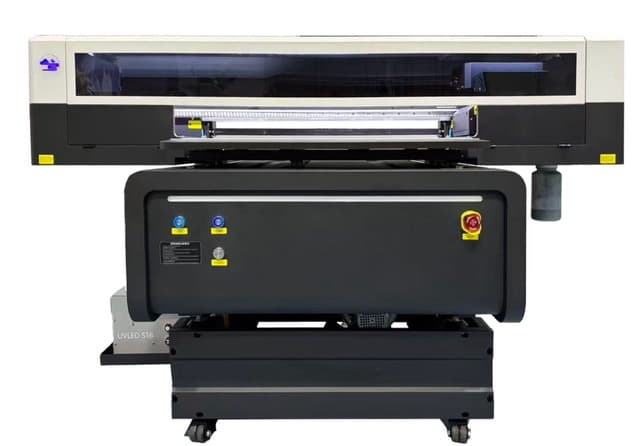
A UV flatbed printer prints flat or low-height parts placed on the bed, individually or in batches with a jig: plaques, signage, housings, corporate gifts. The cylindrical printer rotates the part under the printhead so the design wraps 360° without a seam: bottles, glasses, flasks and tubes. In the catalogue, the RS Pro 9060 UV Hybrid is a flatbed (90 × 60 cm and objects up to 18 cm high) and adds roll-to-roll UV DTF; the RS Pro Bottle XS and the RS Pro Glass 360 are cylindrical.
Digital printing or screen printing and pad printing?
They do not compete on the same ground. Digital printing has no fixed cost per design and reproduces gradients and photographs with no limit on colours, so it wins on personalisation, short runs and many different designs. Screen printing and pad printing lay down more ink, match a Pantone with mixed ink and lower the cost per part on long runs of the same design. IBPRINT works with all three processes, so the recommendation comes from the part and the volume.
What information is needed to choose a printer?
Four things: the material and shape of the part (flat, cylindrical, conical or textile), the maximum print size, the volume (parts per hour or per day) and the finish required: whether a white base, varnish or raised texture is needed. With that information the choice is made between UV and DTF, between flatbed and cylindrical, and the printhead configuration. Each printer is offered on quotation.
Frequently asked questions
About digital printing
Which materials can a UV printer print on?
A UV printer prints directly onto almost any rigid or flexible material, because the ink cures instantly under UV-LED light instead of drying by absorption: glass, stainless steel, aluminium, acrylic, PVC, ABS, polycarbonate, ceramics, wood and leather. Low-surface-energy plastics, such as polypropylene or polyethylene, may need a primer for the ink to anchor.
Can you print on clear glass?
Yes, with a layer of white under the colour so the design does not show through. In the IBPRINT catalogue, the RS Pro Glass 360 is set up for clear, conical or tapered bottles and glasses thanks to its internal scanner of the part; the RS Pro Bottle XS is intended for non-transparent cylindrical objects.
What is the difference between DTF and UV DTF?
DTF is for textiles: it is printed on PET film, a powder adhesive is applied and the transfer is heat-pressed onto the garment. UV DTF is for rigid objects: it is printed with UV ink onto an adhesive film, laminated with a transfer film and the design is applied cold, by pressure, onto cups, flasks, containers or boxes.
DTF or screen printing for printing T-shirts?
DTF needs no screens or colour separation, prints in full colour from the file and works just as well for one garment as for a hundred different designs, on cotton, polyester or blends with no pretreatment. Textile screen printing lowers the cost per garment on long runs of the same design with few colours. For on-demand production and personalisation, DTF is usually the more cost-effective option.
What else do you need besides the DTF printer?
A DTF line needs PET film, pigmented textile inks with white, hot-melt powder adhesive, a system to apply and melt it (manual or with an automatic shaker-oven), a heat press to transfer to the garment and RIP software to manage the colour and the white layer. When requesting a quotation it is worth confirming what each configuration includes.
Do you provide technical service for digital printers?
Yes. IBPRINT carries out preventive and corrective maintenance on UV and DTF digital printers: inspection and cleaning of the printheads and the ink circuit, adjustment and calibration, in the Igualada workshop or at the customer's plant.
How much does a UV or DTF printer cost?
IBPRINT does not publish prices: each printer is offered on quotation, because the cost depends on the format, the number of printheads, the colours and finishes (white, varnish, raised texture) and the peripherals. To guide a quotation, it is enough to state what will be printed, on which material and how many parts per day.